Whether AI should be seen as a tool, collaborator or competitor depends on how each person defines its role in creative projects. Being that everyone has their own opinion on this, and the use of AI isn’t regulated, its up to the users to choose how to use it.
Common themes emerge in online forums on the use of AI: it’s reshaping processes but it can’t replace the human connection behind. Meaning is fostered through the human heart, it can’t be outdone by a machine. “These algorithms [like GPT-3, developed by Open AI,] can create anything from articles and reports to poetry and long-form content. This doesn’t mean human journalists and writers are out of work; rather, AI can take over repetitive tasks and data-heavy content, allowing human creatives to focus on more intricate storytelling aspects” (McCoy, 2024).
AI has become very powerful in the last year alone, the speed of AI development has been accelerated with every company trying out their own idea of AI. Now everyone has access to this new technology, lowering technical barriers. Accelerating ideation and those barriers assists in the prompter’s ability to create something visual within moments. “Collaborative models where AI assists human creators can lead to more innovative and high-quality content. Think of AI as the ultimate assistant that handles the grunt work, leaving you free to focus on the creative flourish that only a human can provide” (McCoy, 2024). In this sense, clearly AI functions as a tool, meant for busywork so humans can focus on creative thinking.
by Paul Melcher, 2024
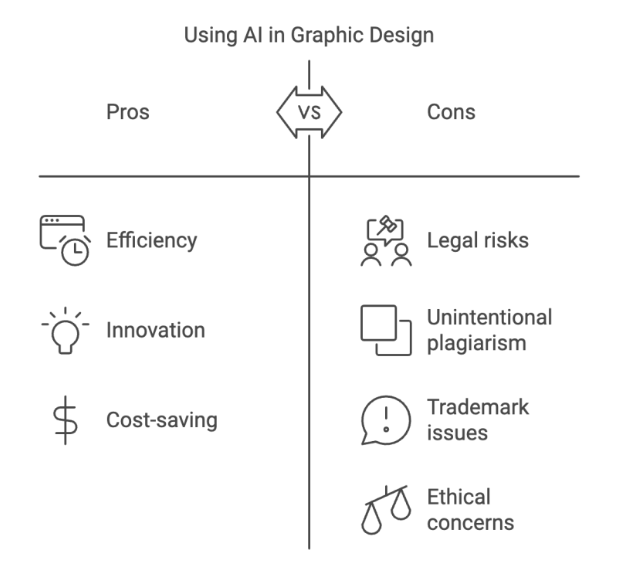
There are downsides to utilizing AI in your work, though. This plays into the ethics of utilizing AI to do your work for you: it’s stealing others’ work. “The use of AI in graphic design introduces new complexities to copyright law and raises concerns about unintentional plagiarism. These issues pose significant challenges for designers and companies alike, with potential legal and reputational consequences” (Melcher, 2024). With increased access comes increased risk, especially since AI is currently going unchecked. Local businesses are using this technology because they can’t afford to hire a graphic designer, and that graphic designer can’t find work because companies are using this tech. “As LLMs improve, there will be less need for copywriters, authors, screenwriters and analysts. It will be harder and harder to sell knowledge” (Cook, 2023).
Another downside is AI having a scrolling model to train itself to answer a user’s prompt is that it takes art from creatives. In order for smaller artists, or even public domain works of art, there needs to be a visual model online for marketing purposes. Digital sales and representations of work are posted to websites and social media to ensure the increase in sales. “If you can see it on the internet, it will be taken. Without our data (or “content”, as corporations like to call it), none of these tools would exist” (Bausenhardt, 2023). AI can’t sort through what’s protected by copyright, it’s something that the creators of the LLMs need to improve. So by having it steal art from artists, where does copyright come in with “original” art being created by LLMs?
Before generative AI came into existence, US federal courts did not allow copyrights to be held by non-human creators. In March 2025, federal courts upheld the court’s decision in Thaler v. Perlmutter, “holding that the Copyright Act ‘requires all eligible work to be authored in the first instance by a human being’” (Zirpoli, 2025). This was a major win for creatives and artists in the United States, furthering the claim that AI can be used as a tool rather than a collaborator – and definitely shouldn’t be used as a competitor.
References
Bausenhardt, J. (2023, February 3). How AI is stealing your art. Julia Bausenhardt: Illustration + Nature Drawing. https://juliabausenhardt.com/how-ai-is-stealing-your-art/
Cook, J. (2023, October 24). AI Is Stealing Your Content. Steal It Back. Medium; The Pro Files. https://medium.com/the-pro-files/ai-is-stealing-your-content-steal-it-back-9c7312f6cf85
McCoy, D. (2024, July 26). The Future of Storytelling: How AI is Revolutionizing Content Creation. Medium. https://medium.com/@docdano/the-future-of-storytelling-how-ai-is-revolutionizing-content-creation-cc517941e767
Melcher, P. (2024, December 18). Ethical Issues in AI Graphic Design: Bias, Plagiarism, and Ownership. Kaptur. https://kaptur.co/ethical-issues-in-ai-graphic-design-bias-plagiarism-and-ownership/
United States Court of Appeals for the District of Columbia Circuit. (2025). Thaler v. Perlmutter No. 23-5233 . In USCourts.gov. https://media.cadc.uscourts.gov/opinions/docs/2025/03/23-5233.pdf
Zirpoli, C. T. (2025, July 18). Generative Artificial Intelligence and Copyright Law. Congress.gov. https://www.congress.gov/crs-product/LSB10922
 Isabella Susino
Leave a comment