
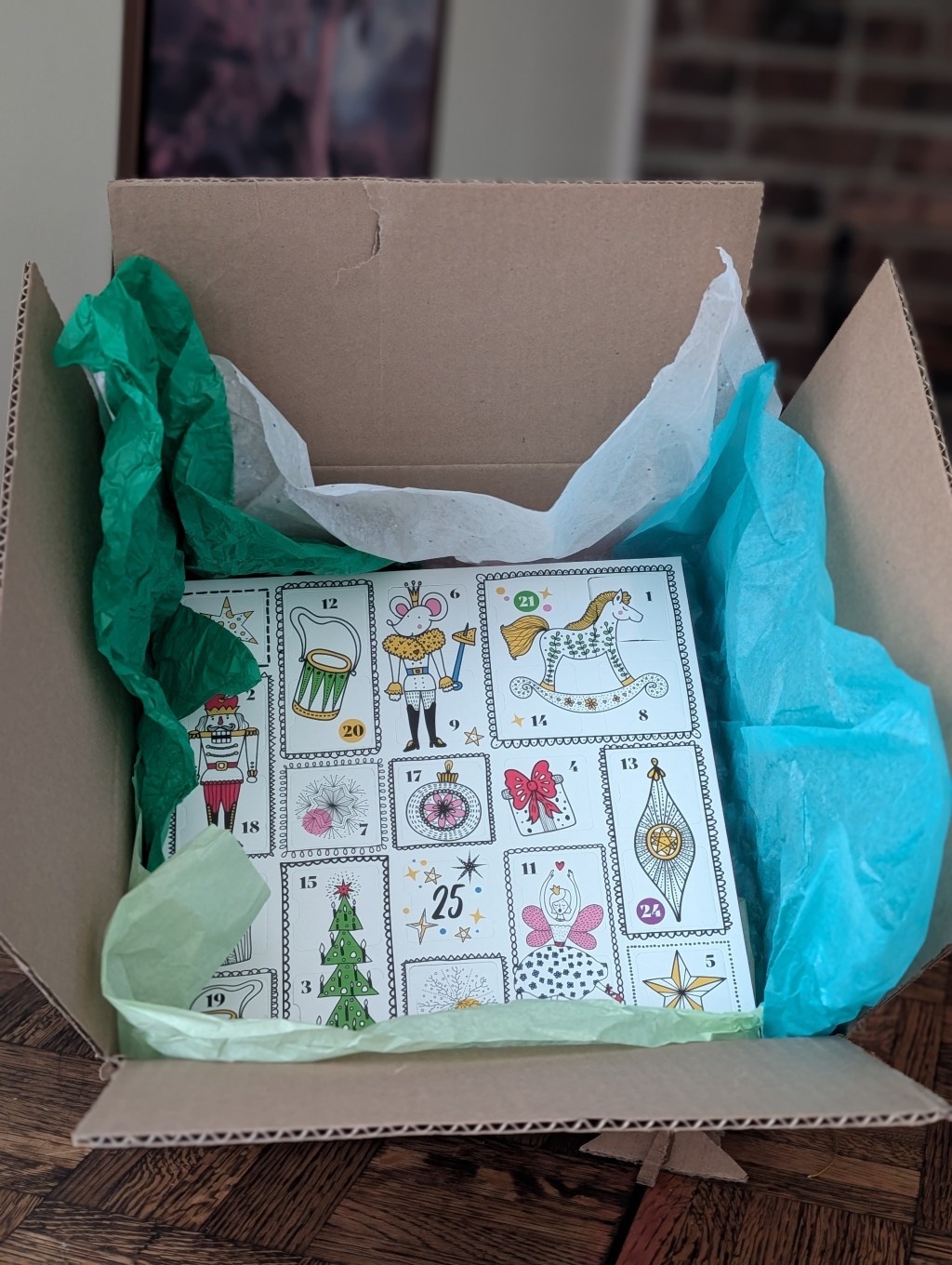
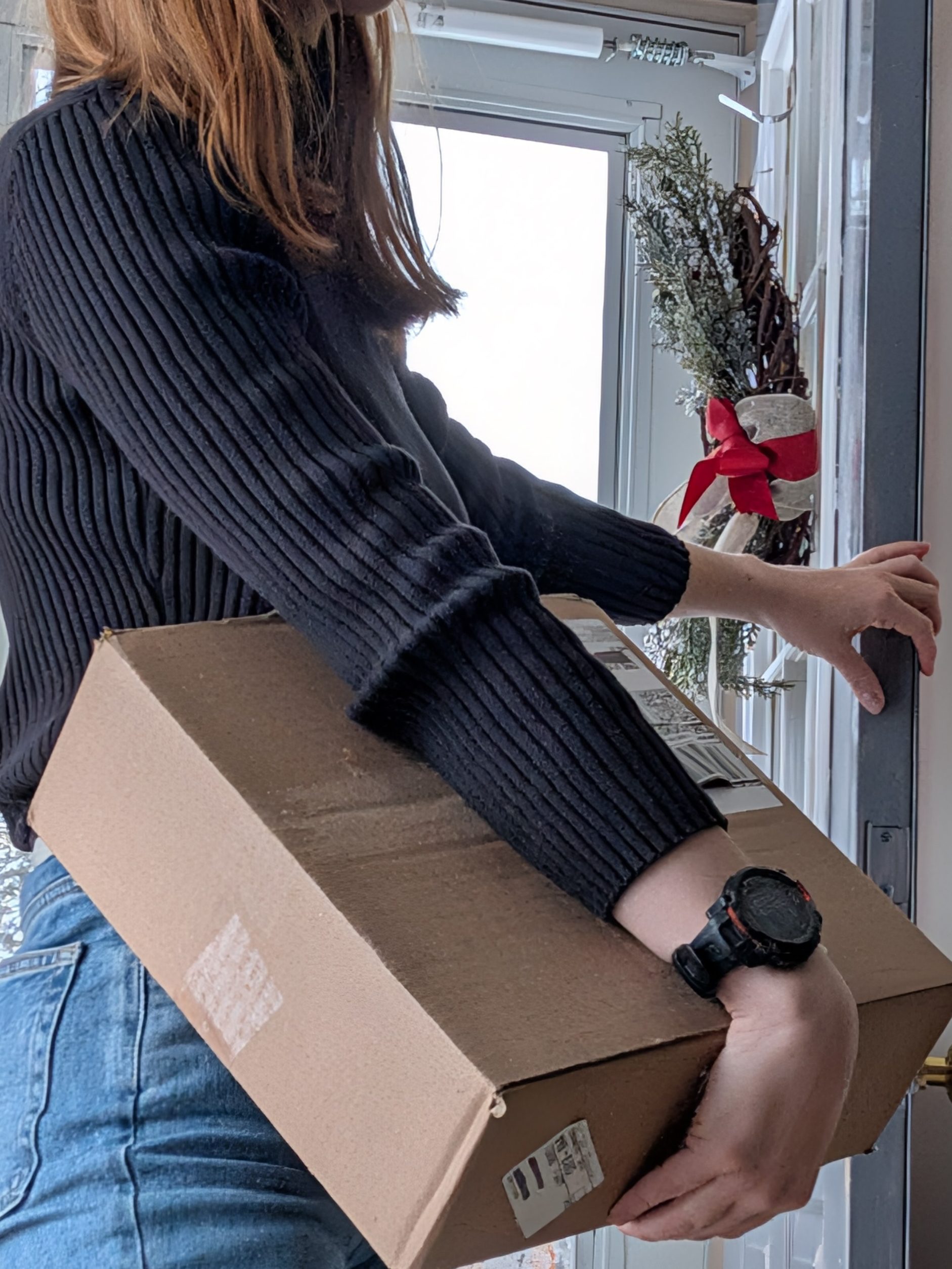
On a morning wrapped in snowy solitude, a woman found a package waiting on her doorstep. Its corners dusted with snow, the label softening the woman’s eyes as she read who it was from. The air bit at her cheeks as she took it inside her home, but there was a small spark of warmth in the simple act of carrying something unknown inside.
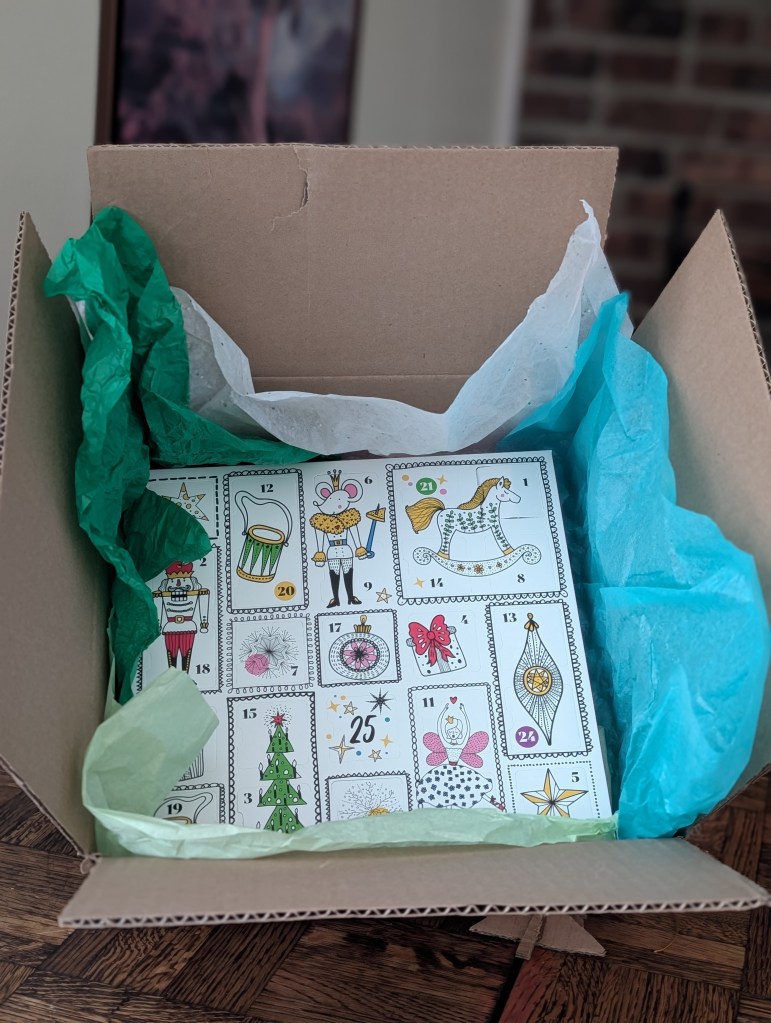
She set the box on her kitchen table, brushed the snow from the corners, and cut the tape with a slow, anticipatory breath. Inside, nestled in crinkled paper, was a chocolate advent calendar. Brightly colored decorations and whimsical creatures on the box promising her a small daily sweet through the dark stretch of winter.
She smiled, feeling that quiet lift in the chest that only small surprises bring. Only her mother knew that these kinds of surprises were actually so pleasing to receive. The woman noted to give her mother a call, for thanks of this gift were definitely needed.

The number “1” waited like a tiny doorway, almost glaring at her that she hadn’t opened it already. She pressed the perforated edge, popped it open, and bit into the chocolate. The warmth unfurling, gentle and steady, in contrast to the frost still clinging to the windows, caramel oozed out and coated her tongue with the rich taste.
The empty box sat beside her, open-mouthed and inviting. She looked at it for a while, feeling the familiar tug of wanting to make something with her hands, to soften the sharp edges of the day with a bit of cozy creation. And the idea shaped itself easily, like it had been waiting: gingerbread houses, not baked but cut from cardboard, not sugared but painted like they had icing.
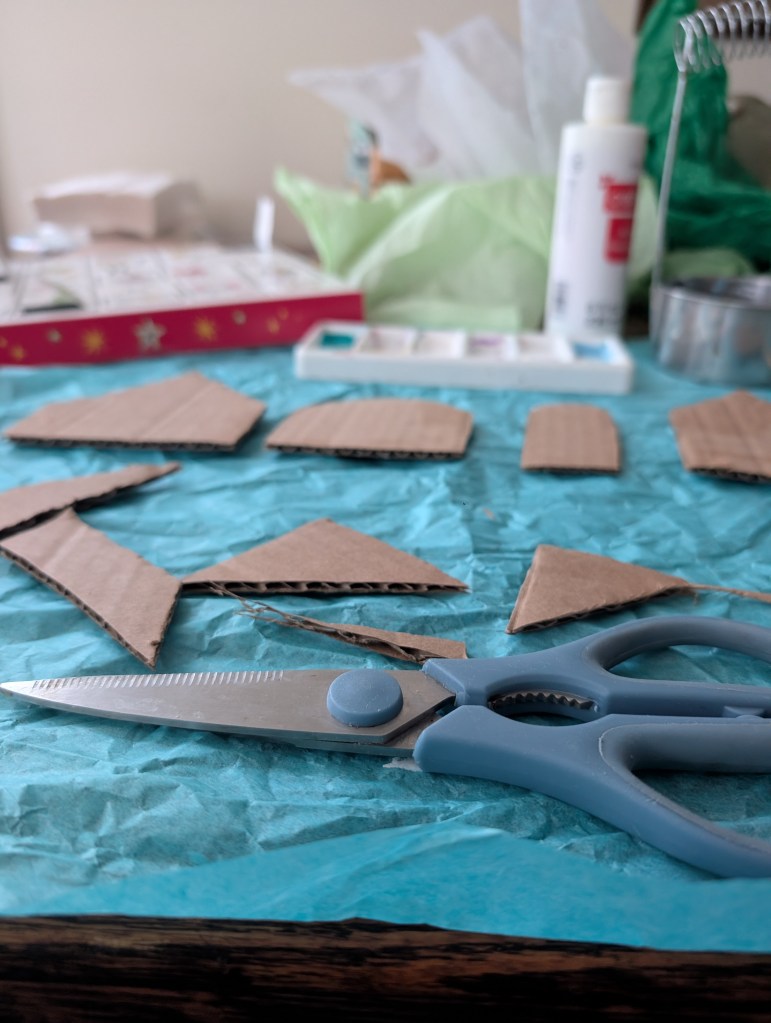
She cleared a space on the table and began cutting the shapes of houses, each slice of the scissors rhythmic, weirdly comforting in the destruction of the box. The cardboard, still chilled from sitting outside, was stiff to cut. The woman eventually finished 10 tiny houses, all different shapes.
She then drew the frosting on with white paint, adding details for the roof, sills, doorways, bushes and trees, swirls, stars, dots and circles for decoration. This part, she thought to herself, was the most pleasing. Creativity flowed through her like melted snow through dry creekbeds.
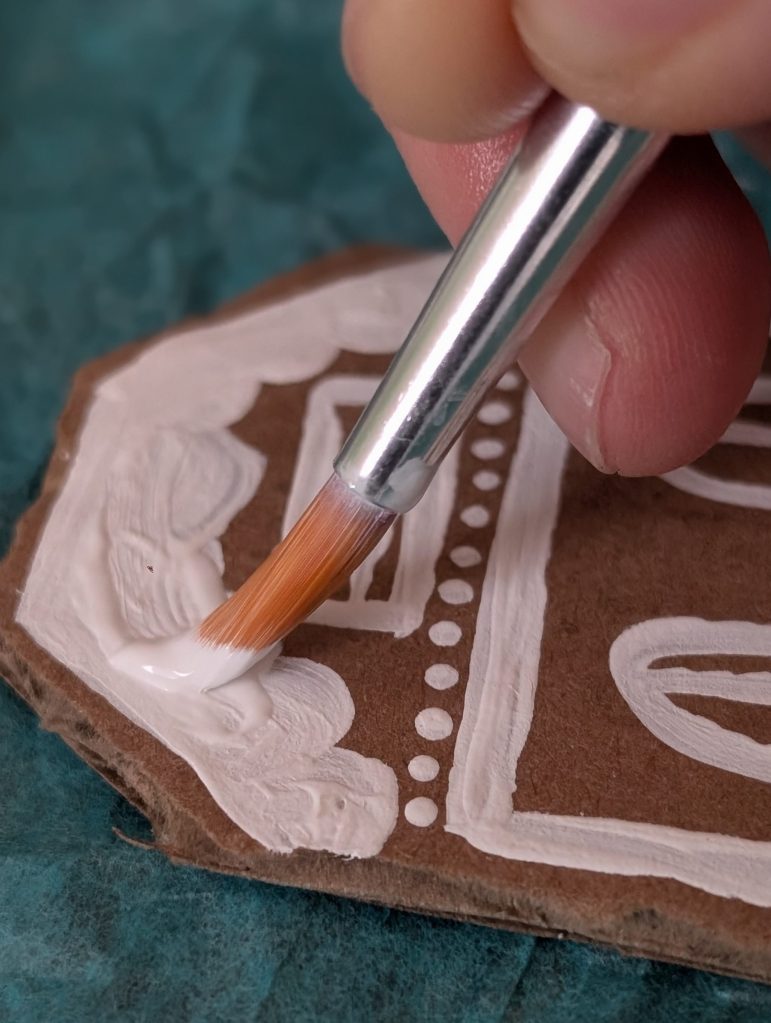
By the time she painted on the final roof, the afternoon light had dimmed into fading grey. Her gingerbread village laid proud and still slightly wet, charming in its imperfection, quiet joy radiated around the apartment.
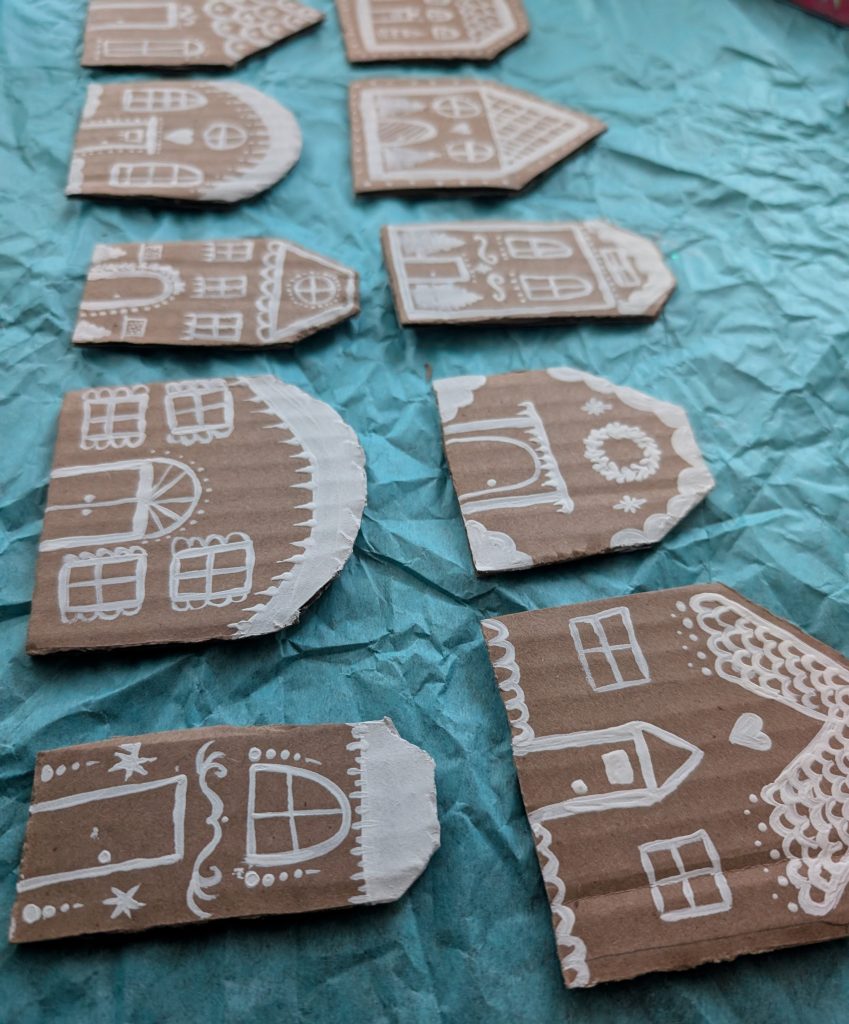
She set the tiny houses in a row to dry. Outside, the snow kept falling, patient and soft, but inside her small creations glowed with their own kind of warmth; a reminder that even on the coldest days, a spark of sweetness can expand into something larger. These Little Houses of December low-waste are just her own. The woman can’t wait to make these houses into a garland.
The purpose of this project was to create a visual narrative built from a series of photographs that demonstrate how design principles shape perception, guide attention, and evoke meaning. Or simply put: to create a photo essay. Inspired by a chocolate advent calendar that my mother sent me as a surprise, the 10 Little Houses of December inlcude elements of design principles (and the photos that were taken of them).
From the beginning, my goal was to build a set of images that not only stood on their own but also worked collectively with the story to show how viewers organize visual information and make sense of what they saw. Each photograph was an opportunity to apply principles of perception studies and design, turning abstract ideas from the course modules into visual representations.
To begin, I categorized my images in three interconnected ways: subject matter, visual structure, and perceptual function. Some photographs are grounded in everyday scenes, human-centered moments, and in object-focused compositions. Storytelling using images that people can identify with helps viewers be put in the shoes of the storyteller – think of the image of the woman bringing in a package from outside, and the one of her eating the bonbon. To include an image of someone actually biting into food instead of an image showing the with just a bite taken out of it was on purpose. I wanted the audience to experience multi-sensory design.
Theories of perception establish how viewers interpret sensory information as cohesive forms. By applying figure-ground relationships, I ensured each photograph gave the eye a clear entry point. This relates directly to principles from Gestalt psychology, particularly in figure ground. These principles shaped how I arranged elements within the frame. For example, images using similarity relied on repeated shapes to create visual unity, while images using proximity allowed clustered elements to form natural groupings, guiding the viewer’s understanding without directly laying it out.
Depth cues were a principle where spatial layering mattered. Linear perspective, occlusion, and relative size helped create a sense of distance and dimension. These cues anchored more complex layouts, preventing them from feeling flat or disorganized.
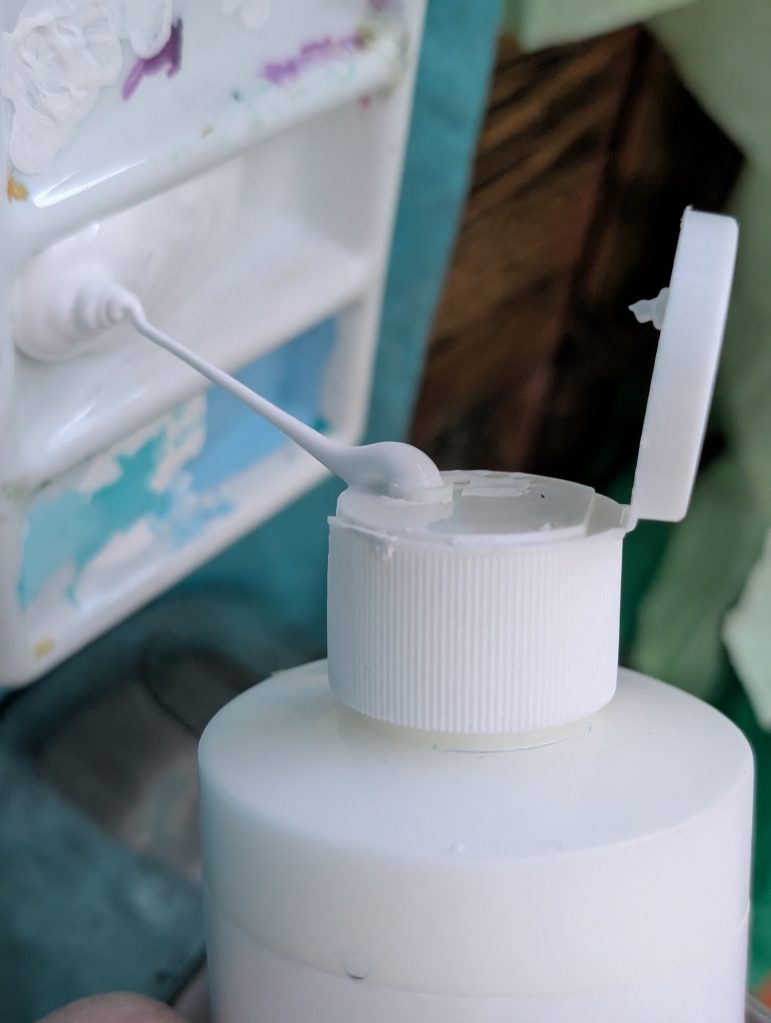
Visual hierarchy is a concept tied to both perception theory and interface design. Through variations in scale, contrast, and focal sharpness, I emphasized what the viewer should notice first. Even photography, certain shapes, angles, or contrasts imply action or meaning, drawing the viewer into an interpretive process. One photo in particular comes to mind: the bottle of white paint titled “Icing drips from the pipette.” I originally took this image horizontally, but flipped it 90 degrees to the left to have the image in vertical alignment. This was for two reasons: 1) to create unity through the piece, and 2) to have a boring image be turned into something of interest for the viewers.
Throughout the project, I used several practical techniques: adjusting focal depth to control emphasis, evoking emotion through imagery, aligning compositions along natural lines of continuity, managing contrast to strengthen figure-ground separation, and experimenting with cropped viewpoints that invited the viewer to mentally complete the image, activating the Gestalt principle of closure.
Ultimately, the project was an exercise in transforming theoretical principles into a real practice. Each photograph reflects deliberate choices shaped by seven major concepts: perception theory, Gestalt principles, affordances, visual hierarchy, depth cues, emotional design, and behavioral economics. Together, these ideas shaped a cohesive and intentional body of work grounded in the ways people see, think, and feel when they encounter visual design.
References
2 Chicks with Chocolate. (2025). 2 Chicks with Chocolate. https://2chickswithchocolate.com/
Bonner, C. (2014, September 15). Using Gestalt Principles for Natural Interactions. Thoughtbot. https://thoughtbot.com/blog/gestalt-principles. From module 4.
Buday, R. (2020). The Reality of Design Fiction: How Storytelling Can Save the World. Common Edge. https://commonedge.org/the-reality-of-design-fiction-how-storytelling-can-save-the-world/. From module 2.
Busche, L. (2015, October 5). Simplicity, Symmetry and More: Gestalt Theory and the Design Principles It Gave Birth To. Canva. https://www.canva.com/learn/gestalt-theory/. From module 4.
Eman Shurbaji. (2014, December 17). Photo narratives. Medium; Ideas: Journalism + Tech. https://medium.com/learning-journalism-tech/photo-narratives-d77b812f99dd. From module 5.
From Business to Buttons. (2023, June 8). FBTB 2023: Ellen Lupton – Storytelling and Visual Design. YouTube. https://www.youtube.com/watch?v=9YcSdkUzok8. From module 2.
https://www.smashingmagazine.com/author/chiara-aliotta. (2023). Five Steps To Design Your Product With Powerful Storytelling — Smashing Magazine. Smashing Magazine. https://www.smashingmagazine.com/2023/02/sell-product-powerful-storytelling/. From module 2.
Marquez, A. (2017, November 1). Introduction to Multi-sensory Design. Akna Marquez. https://www.aknamarquez.com/blog/2017/7/23/what-is-multi-sensory-design. From module 4.
Northern Michigan University. (2024). depth_cues [Art & Design Foundations]. Nmu.edu. http://artnet.nmu.edu/foundations/doku.php?id=depth_cues. From module 4.
 Isabella Susino
Leave a comment