

An image is a visual representation of something. “An image can be two-dimensional, such as a drawing, painting, or photograph; or three-dimensional, such as a carving or sculpture. Images may be displayed through other media, including a projection on a surface, activation of electronic signals, or digital displays; they can also be reproduced through mechanical means, such as photography, printmaking, or photocopying. Images can also be animated through digital or physical processes” (Wikipedia).
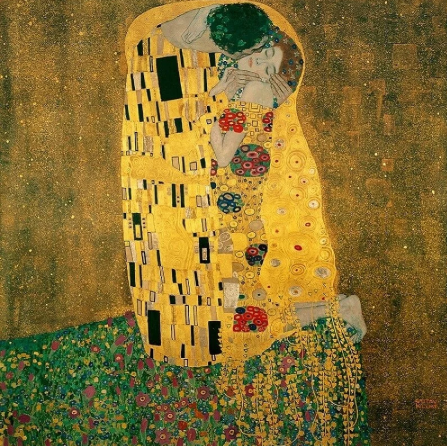
The Kiss by Gustav Klimt
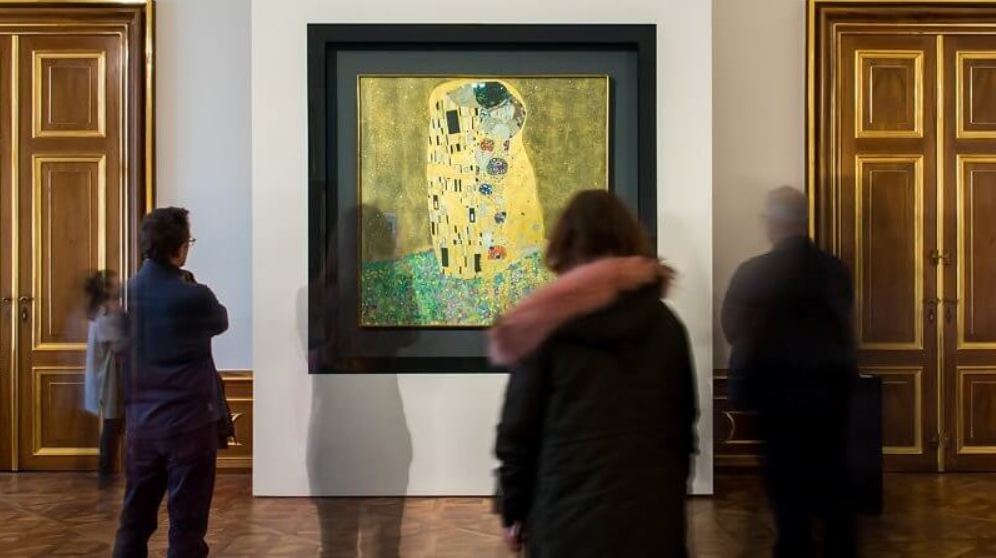
This work is the most famous by this painter. Millions of people travel to see it in-person at Vienna’s Austrain Gallery. It’s an imposing 72inx72in (6ftx6ft) painting, capturing the attention of the room its in. The gold leaf that is a part of the painting reflects the light of the room, giving the depicted couple a golden light. This was also the final painting of Klimt’s “Golden Age,” because of his use of gold leaf and the productions of this period being his best works.
Painted between 1906 and 1907, The Kiss was inspired by Byzantine mosaics from San Vitale, a basilica in Ravenna, Italy.
After seeing the mosaics inside the basilica online, it is understandable that Klimt was so inpired and empassioned. The mosaics, some finished in 547 AD, are brightly colored and have a lot of depth to them. Klimt’s painting style mimicks this mosaic pattern with the different shapes making up each of the couple.
The woman being decorated with softer shapes like cirlces and having delicate flowers under her body, almost bleeding, makes us think that Klimt perceived women to be the fairer of the sexes. Perhaps he even thought that to have her bleed the golden flowers would infer to the ability to childrear. The wave of the golden outline is like a cape, robe or extra outer layer, maybe an extra layer of protection by deities.
The dominant male force is signified by the powerful coat of masculine black and gray blocks, softened by the feminine organic scrolling, reminiscent of “Tree of Life.” In comparison, female energy is shown as spinning circles of bright floral motifs and upward-flowing wavy lines.
Gustav-Klimt.com
The man with the hard lines of squares and rectangles, and the rigid outline of his depiction, infers the rigidity of the masculine stereotype of that age. With the crown of ivy, there are many possible meanings for this: the circle meaning never ending love; a reference to Dionysus, the Greek God of wine-making, orchards and fruit, vegetation, fertility, festivity, insanity, ritual madness, religious ecstasy, and theatre; and in Greek hsitory, they would crown athletes with it and it symbolized intellectual success.
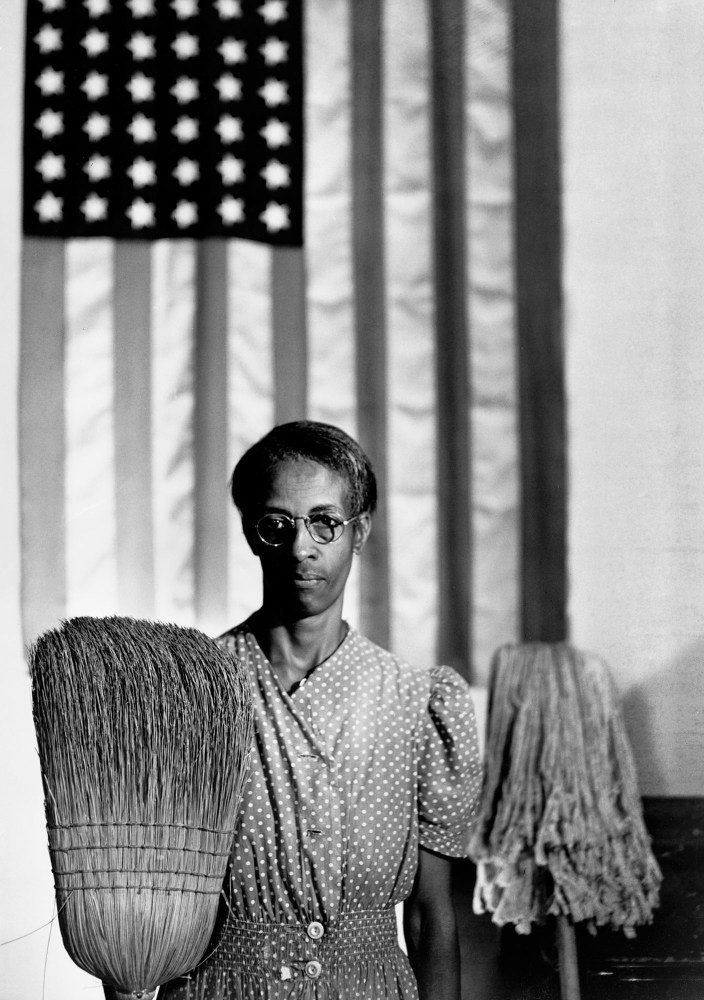
American Gothic by Gordon Parks

A reinterpretation of American Gothic by Grant Wood, 1930 (shown to the left), this photograph shows Ella Watson with a broom and mop in front of an American flag. The photographer, Gordon Parks, moved to Washington, DC to begin his career with the Farm Security Administration (FSA) in January 1942.
Eager to document the African American community in DC, like he did in Chicago, the rampant racism in the city was disheartening. Starting closer to “home,” Parks asked Ella Watson, the office cleaner, if he could take her photograph. Through Watson, Parks was given an opportunity to take more photographs and got his “in.”
An intimate perspective on the reality of life for Blacks beyond the historical gleam of white Washington, D.C.: crumbling homes, trash-filled neighborhoods, and childhood lessons on the street. [Parks] photographed families gathered around meager tables, pensive in their sparsely furnished homes, and attentively negotiating their surroundings in the city. He also took joyous photos of life within the walls of Watson’s church.
Gordon Parks Foundation
The juxtaposition of the black woman with a broom and mop in front of a national incon of the Amerian flag is staggering. In 1942, just 77 years after the civil war ended, the blantant racism and mysongeny was (and still is) a hardship on minority groups.
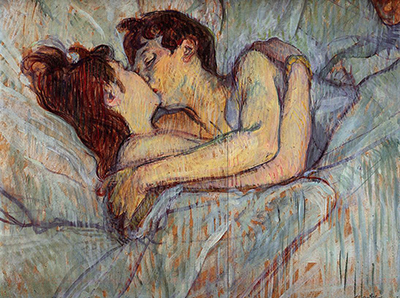
In Bed The Kiss by Henri Toulouse-Lautrec
A sensual kiss shared between same sex lovers in bed, the painting seems private and comforting. The blue tones with some rusty red highlights give off the relaxing vibe of the couple, with the red indicating lust or love.
Created in 1892, In Bed The Kiss is tender and was modern for its creation year. Same sex couples lived a private life in this time period, showing Toulouse-Lautrec’s connection to the LGBTQ+ community.

Natalie Krik in 100 Visions of Motherhood by The Luupe
This collection of images and words curated by The Luupe celebrates the complexities of motherhood.
This particular image by Natalie Krick caught my eye due to the vibrant contrast between the yellow and greens. Upon reading the caption, I was intrigued and decided to research this more. Guy Bourdin was a highly experimental photographer based in France, capturing high color and provocative images that pushed the boundaries of fashion photography. “He was among the 1st to create images with narratives, telling stories and shows that the image is more important than the product which is displayed” (The Guy Bourdin Estate).

To the left is one of the images that can be speculated to be the inspiration for Krik’s photograph with her mother. Going to the Estate’s website, you can see that Bourdin’s photography was extremely sexual in nature for the time period in which they were taken.
Bourdin was a key photographer for French Vogue from 1955 to the late 1980s. His critics have accused him of misogyny and objectification, making the models glassy eyed and more mannequin-like rather than humans.
And in a number of photographs, only disembodied legs appear, striding down streets or beside the sea. Women’s body parts are fetishized, becoming things separated from the real person they were once attached to.
Melissa Bailey Blog, 2015
With all of this being said, Natalie Krik’s imitation of these photos mocks Bourdin’s photography. She puts both her and her mother into the shape of the open legs, and by doing this she shows the human beings behind the photograph instead of dismembered pieces. They also seem to be embracing each other to hold this pose, a mother’s tender love for her daughter, and further mocking Bourdin. The models he used were always someone’s daughter and/or mother, and without that key piece, he missed the opportunity to show women’s strengths in a fashionable and sexy way.

Migrant Mother by Dorthea Lange
During the Great Depression (1929-1941), the Resettlement Administration was formed to raise public awareness of and provide aid to impovershed farmers. Dorthea Lange was hired as a photographer for the program’s photodocumentary project to draw attention to the plight of the rural poor.
During her travels, she drove past a sign reading, “PEA-PICKERS CAMP,” in Nipomo, California. Pictured is picker Florence Owens Thompson and her children, at a camp filled with field workers whose livelihoods were devastated by the failure of the pea crops.
The image is powerful, with the focus being on Owens Thompson’s face, caught in worry. The older children are resting their heads away from the camera, the only child’s face in view is the hidden babe in her arms.

Photo by Angela Strassheim
Alicia in the Pool by Angela Strassheim
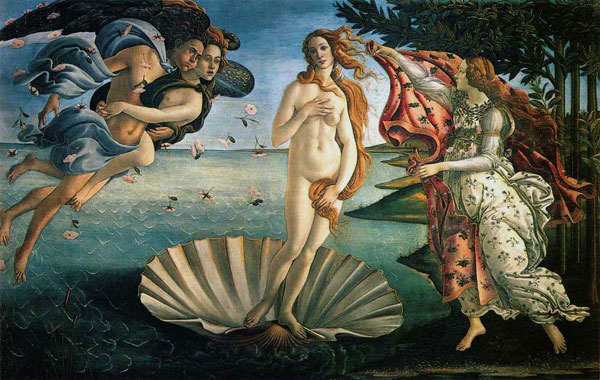
This photograph was staged to imitate Birth of Venus by Sandro Botticelli. With the young girl’s innocence paired with the hanging sheets, inflatable pool, and what appears to be a diaper above the basket, it’s foreboding image. Motherhood shown in this way with the white swimsuit and sheets can almost be seen as pure. What’s hiding in the image is the unseen work of mothers.
The grey ball is at her feet, like a pearl. Almost a Mandela Effect, there is no pearl in the original Birth of Venus painting (as shown on the left).
The looming grey grain silos over the innocent scene draws the eye upward toward the head of the girl. It seems to have the opposite effect as the Botticelli painting, where your eye is drawn immediately to Venus.
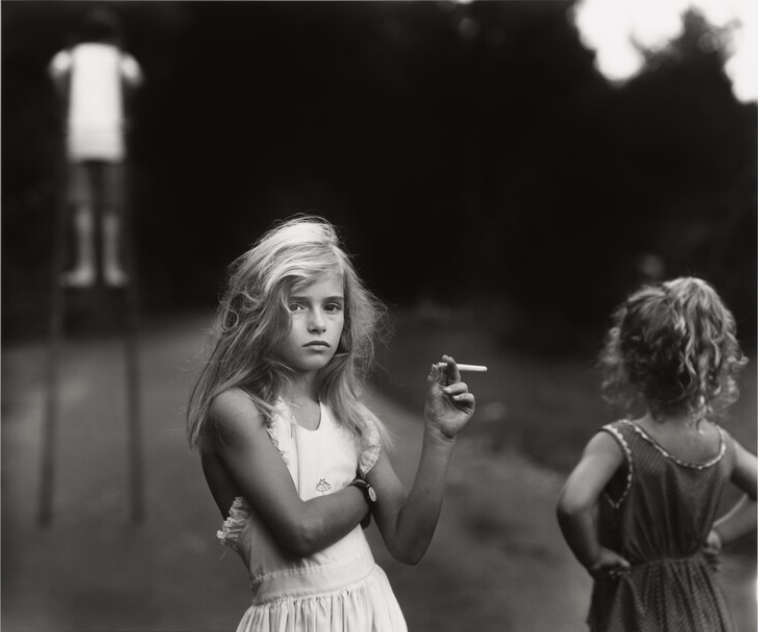
Candy Cigarette by Sally Mann
In Sally Mann’s Candy Cigarette, the viewer is immediately drawn to the unsettling image of a young girl holding what appears to be a cigarette. At first glance, it’s a moment of childhood rebellion, but upon closer inspection, it becomes a profound commentary on innocence, imitation, and the performance of adulthood.
Mann captures her daughter, Jessie, in a candid yet carefully composed scene that blurs the line between play and maturity. The girl’s confident pose and direct gaze contrast sharply with the carefree gestures of the younger children in the background, emphasizing the transition from childhood to adolescence. Mann often photographed her children in natural, unguarded moments, exploring themes of family, identity, and the fragility of youth. The stark black-and-white tones enhance the tension between purity and experience, beauty and discomfort. Candy Cigarette encapsulates Mann’s ability to provoke deep emotional reflection through an image that feels both intimate and universally human.
In closing
Across these diverse works of art, from Klimt’s golden lovers to Mann’s haunting photograph of a child with a cigarette, a common thread emerges: the image as a mirror of human emotion and experience. Each artist uses their chosen medium to explore intimacy, identity, and the social contexts that shape perception. Klimt celebrates sensuality and the divine nature of love; Parks exposes racial inequality beneath a patriotic symbol; Toulouse-Lautrec and Krick challenge societal norms around sexuality and representation; Lange and Strassheim reveal the quiet endurance of motherhood; and Strassheim and Mann confront the complexities of innocence versus maturity. Together, these images remind viewers that art is not just a visual experience, but a reflection of the human condition, capable of stirring empathy, discomfort, and understanding all at once.
 Isabella Susino
Leave a comment