
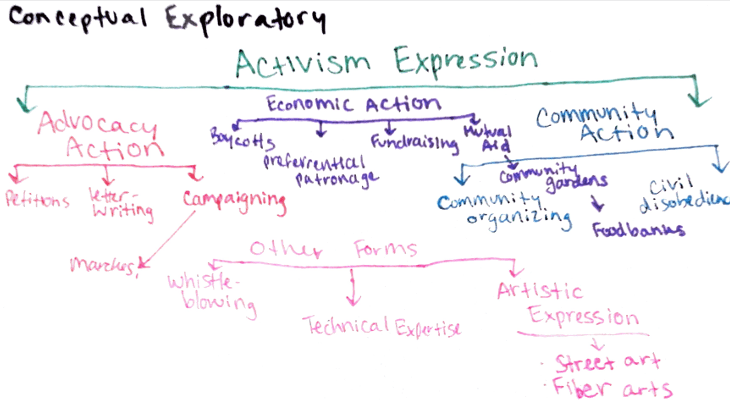
Activism has taken many forms, from large-scale demonstrations to internal resistance. While the methods differ, each shares a purpose: to challenge the current state of affairs, influence decision-makers, and build community meaning.
In order to build a conceptual exploratory data model, I’ve divided these themes into 4 topics: community action, economic action, advocacy action, and other types of actions.
Community Action
Community action focuses on collective participation, often in public spaces or through grassroots organizing. These methods emphasize visibility and direct actions to challenge the systems in place. Best done as a collective action; the more people, the better.
- Marches and rallies: Public demonstrations with signs, banners, and speeches to express dissatisfaction and build solidarity.
- Sit-ins: Occupying spaces and refusing to leave as a form of resistance.
- Strikes: Workers collectively withholding labor to demand better conditions or rights.
- Community organizing: Building local networks to identify problems and act collectively. Think of presidential campaigns, how they get a big volunteer base and then have the volunteers go out to complete different parts of the campaign strategy.
- Civil disobedience: Intentionally breaking laws considered unjust, typically in a non-violent manner, to call attention to injustice.
Economic Action
Economic action uses financial choices and resource-sharing to push for change. These tactics recognize that economic systems are deeply tied to social and political power. Most of these can be done as a collective whole or on the individual basis.
- Boycotts: Refusing to purchase certain products or services to protest harmful practices.
- Preferential Patronage: Supporting businesses that align with your values, or refusing to support the businesses that are against them.
- Fundraising: Raising money to support organizations, campaigns, or grassroots movements. Sometimes this can be donating towards someone’s gofundme, or venmoing your friend some money for a surprise mental health coffee break.
- Mutual Aid: Communities collect resources to meet needs outside of traditional institutions. This can look like community gardens or food banks, but usually hyper-focused on one particular area of a community.
Advocacy Action
Advocacy action engages with decision-makers, policies, and institutions. These strategies generally operate within formal political and legal systems. These have more to do with engagement with folks outside of yourself, and getting them to then mobilize.
- Petitions: Collecting signatures to demonstrate public support for change.
- Letter-writing: Directly contacting officials, corporations, or organizations to express demands.
- Campaigning: Supporting political candidates or movements aligned with activist goals.
- Advocacy and Lobbying: Promoting causes, providing information, and pushing for legislative or policy changes.
Other Forms of Action
Not all activism fits neatly into community, economic, or advocacy categories. Some approaches rely on creativity, personal risk, or specialized skills. Most of these are done as individual action, but there are larger projects that need a community base.
- Artistic Activism: Using performances, music, or visual arts to inspire and inform. This includes streetart like murals, graffiti or art instillations – all of which convey public messaging.
- Whistleblowing: Exposing unethical or illegal practices within organizations to the public.
- Technical Expertise: Applying knowledge in fields like science, law, or technology to strengthen efforts.
Here is the final conceptual drawing:
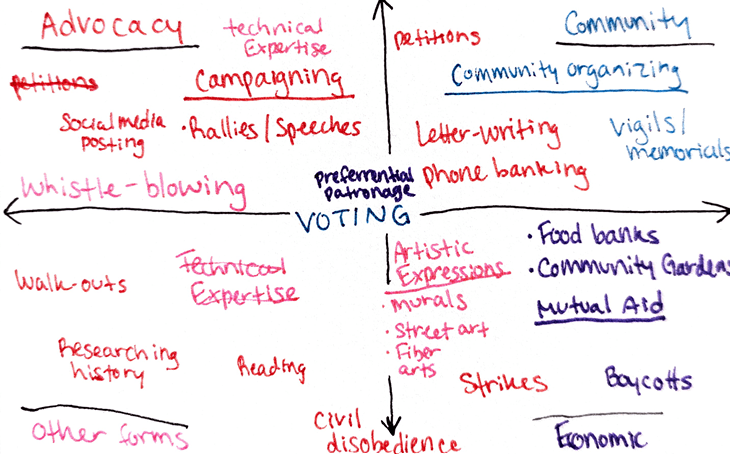
I chose to do create the model like this because of the affiliation this type has with different political beliefs. It’s recognizable, and is identifiable. It’s familiar, so people can understand what it is they’re looking at.
If I ever decide to recreate this, I would choose different colors. The pink and red look too similar after scanning the index card. I would also explore the independenct vs collective action on a scale like this, and maybe break down the actions into engagement vs mobilization as well.
References:
https://www.humanrightscareers.com/issues/types-of-activism/
https://en.wikipedia.org/wiki/Activism
https://www.liberties.eu/en/stories/activism/44871
https://commonslibrary.org/the-activist-handbook-campaigning-guides-for-activists/
https://lifeattheintersection.com/2024/08/05/kind-of-activism-is-right-for-me/
 Isabella Susino
Leave a comment