
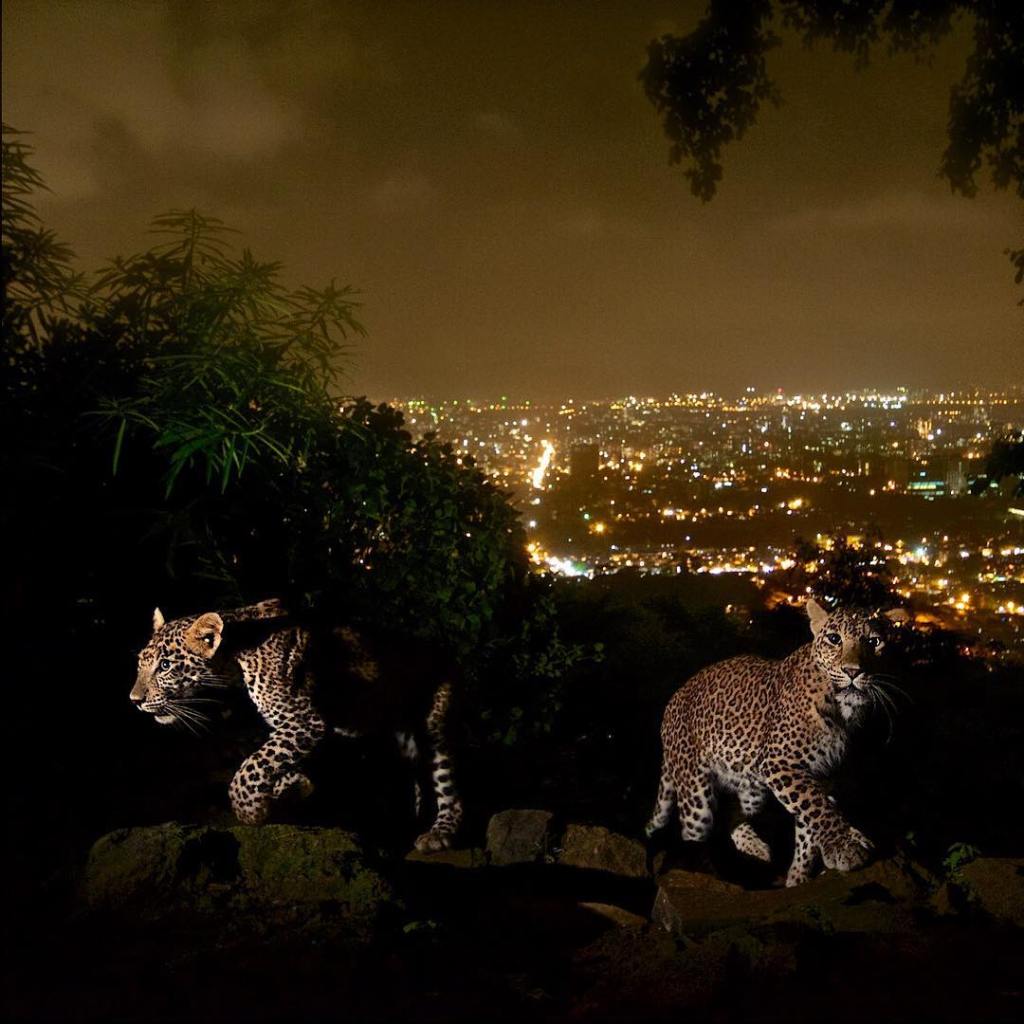
The first time any viewer sees an environmental photograph, their breath is caught in their chest. Often depicting the living or working conditions or those with amazing skills, National Geographic Magazine and their photographers are known for doing this kind of work. The reason why these photos exist are because of the conditions of living. For example, the photo of the Leopards shown below.
The caption on Instagram reads:
“Here is more proof that we humans live with majestic animals in urban areas without even knowing they are there – AND without major problems – if we let them be. Leopards are the most adaptable and the most persecuted cat on our planet. …”
These photographs are essential to raise awareness for all beings out in the world that need the attention of the mass media. Seeing the leopards so close to a civilization made some understand that deforestation is a rapidly growing problem. These animals are looking for places to reside in since their home is gone, they have nowhere left to go besides populated areas.
An environmental portrait is a photo taken of a subject or subjects in a certain situation that they live in and a place that says something about who they are. Typically, these photos are taken in a place of work, rest or play.
This type of photography is important because it gives context to the subject that the photo is of or the story you are trying to convey. These photos give different points of interest to the shots, but the photographer doesn’t want to distract too much from the subject of the photo. Taking these types of photos can also give some sort of relief to the subject and helps them relax more – the photos will seem more natural this way. Usually, these types of photos sit somewhere along the lines of portrait and candid, the one you want is of them going through with their day-to-day lives. Lastly, these shots will give viewers real insight into the personality and lifestyle of the subject.
Here are some tips for photographers looking to increase their skill in taking environmental photos:
- Spend some time getting to know your subject:
-
- Ask them insightful questions for your better understanding of how to depict them in the shot.
-
- Find out where they spend their time.
-
- Observe their personality first hand.
-
- If possible, accompany the subject to some locations to see both how they look, but also to see how the subject behaves and interacts there.
- Choosing a location:
-
- Sometimes a location chooses you, but other times you need to be deliberate and purposeful in finding a good location.
-
- Find a location that says something about your subject, adds interest to the shot and one that doesn’t dominate the shot.
-
-
- Sometimes a location can take away the viewer’s attention so much that the subject is lost as the main focal point.
-
-
- Try to avoid cluttered backgrounds and foregrounds, colors that are too contrasted.
-
- Keep in mind that it’s possible to decrease the distraction with cropping, depth of field and subject placement.
- Props:
-
- If they are subtle, necessary and naturally fit in with the context of environment. If not: do not add them – they can be distracting.
-
- Clothing: be true to the context and cultural lifestyle of the subject.
- Posing:
-
- Candids are usually the best, when the subject is going about their day-to-day life and not paying too close attention (or none at all) to the camera.
-
- Don’t be afraid to ask the subject to do something, but nothing too dramatic. Sometimes purposefully posed photos give a sense of style to the shot.
-
- Facial expressions: a necessary element when taking an environmental photo. For example: if the environment is formal or has a serious nature, a big cheesy grin is not appropriate. Feel free to mix it up and see what works for you and the subject.
- Camera settings:
-
- Depends on the environment of the shot. A smaller aperture (the larger numbers) will be appropriate as it will keep the foreground and background within focus.
-
- Natural lighting is the best bet – flash will never look natural.
-
- If the environment allows, bring supplemental lighting like a soft light to enhance the environment.
-
-
- *Bringing another light can make the subject tense and will slow down the process.
-
- Try to take the pictures when the subject isn’t expecting it.
-
- Sometimes subjects over dress or put extra makeup on specifically because they know their photos are going to be taken that day.
These types of photographs have been seen by thousands of people and helps to put reality into place for them. They can be used in [almost] all environments and help to piece together the story the photographer or writer wishes to convey.

 Isabella Susino
Leave a comment