
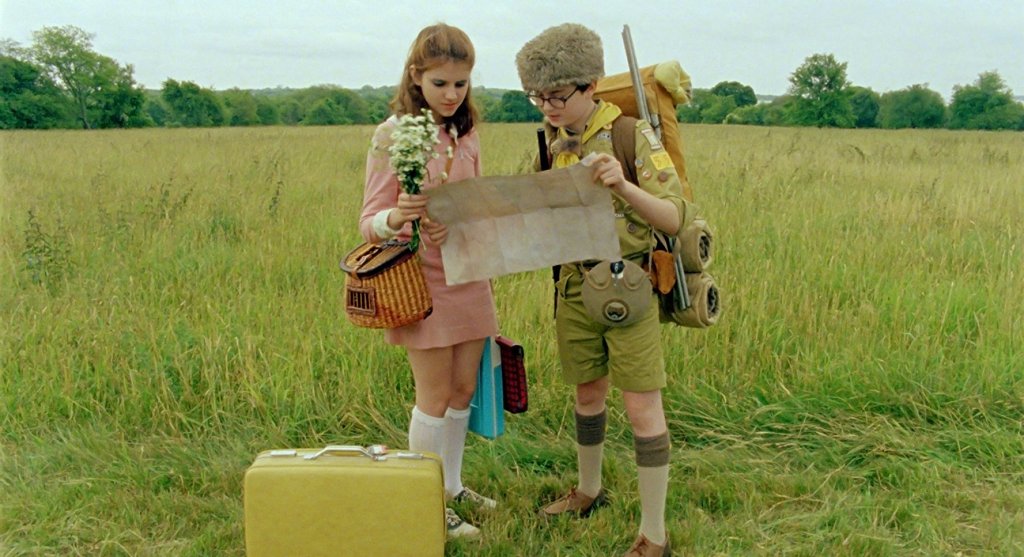
This film was Directed by Wes Anderson and written by Anderson and Roman Coppola; it was released in 2012 and is rated 7.8 out of 10 on IMBD.
The story begins in September 1965, on New Penzance Island. The audience first meets a 12-year-old girl named Suzy Bishop (Kara Hayward) and her family: three little brothers and her mom (Frances McDormand) and dad (Bill Murray). Next, the narrator (Bob Balaban) breaks the fourth wall and talks to the audience and shows them around the island, he includes that he is a meteorologist of some sort and conducts multiple tests for the humongous incoming storm – in 3 days time. The next introduction is with a tour of Camp Ivanhoe, a boy-scout equivalent in this film. The audience meets the troop members and their Scout Master, Randy Ward (Edward Norton). The troop finds out that Sam Shakusky (Jared Gilman) is missing from the camp and is reported as such and as a thief to the Police Captain, Duffy Sharp (Bruce Willis). Search party ensues, they are found, escape again and they make a conscious choice to live in harmony with everyone after all.
Mise-en-scene
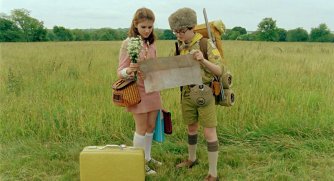
This scene is from the first act of the film, it depicts a young girl and a young boy looking at a sheet of paper. The paper looks like it had been worn and folded many times, but the edges had been preserved very well so it must be important. The young people have luggage and a camping backpack with them, so they must be going on some sort of trip together. The sheet of paper might be a map then, or something very similar to that. The boy looks like he has some sort of uniform on, it has patches – but not military so he must be something like a boy scout. The girl is carrying wildflowers in her left hand, maybe it means that he gave them to her meaning something romantic. The location where the young people are standing is really grassy and open, so it must be in the middle of a field or meadow, why would they meet so far away from town?
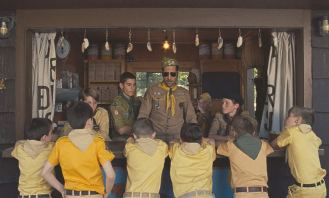
In this scene, there are 11 males all dressed like boy scouts again. The one in the middle with the sunglasses looks as if he is in charge of something, perhaps this is some sort of store? The body language of the boys in the front of the counter seem disappointed with the outcome of a question, the one in charge could have told them something disheartening? There are storage shelves in the back and a long the walls, most of the words are ineligible. There’s a scale on the left side, what could they possibly have to weigh with that kind of scale at a boy scout camp? At first, the things hanging from the outer edge of the hut looked like lights, but they are rabbits’ feet – presumably to sell for good luck. The curtains on either side of the open window look like they have words written on them, maybe to indicate whether or not the hut is open or closed.
Narrative techniques
This film does have a three-act story structure and is shown by introducing all of the characters in the first act and introducing a conflict. The conflict is the relationship between the other Khaki Scouts and Shakusky and the tense relationship between Suzy and her parents, the parents’ relationship, Mrs. Bishop with Mr. Sharp and then the new tension that arises between the parents and Scout Master Ward. The second act can start to be recognized by the confrontation of the Khaki Scouts in the woods when they find the young couple making their way along the old Chickchaw harvest migration.
However, there are multiple parts that lead into the climbing action: 1) the young couple is found on their inlet and taken back to where they were before, 2) the Khaki Scouts help the couple escape again, and 3) the group takes a journey across the channel to the larger and more inhabited St. Jackwood Island to see Cousin Ben (Jason Schwartzman). One of the other Khaki Scouts suggests that Suzy and Sam see Cousin Ben because he has ties to get away from the life they were living on New Penznace Island. “There’s a cold-water crabber moored off Broken Rock. The skipper owes me an I.O.U. We’ll see if he can take you on as a claw cracker. It won’t be an easy life, but it’s better than shock therapy.” (Cousin Ben- 1:06:37 – 1:06:44 Moonrise Kingdom (2012) Universal Pictures).
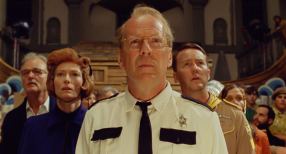
The storm would be categorized as the climax of the film, the young couple was in the church for safety – yet with everyone who was trying to find them, they still almost escaped if it weren’t for the heroic character development of Captain Sharp. Even with this film being a drama, the audience has to be relieved when Suzy and Sam are able to live life together again and see each other everyday.
Cinematography
Cinematography is often used to convey meaning to the audience on how characters feel in that moment. Camera angles and different shots can make a scene compelling to the audience and is able to capture their complete focus.
Framing
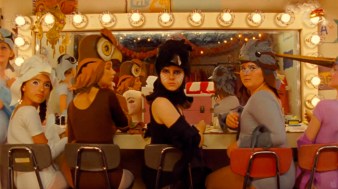
Wes Anderson often uses framing to really make the difference in getting to know characters or to just develop his style. Usually, Anderson has very symmetrical scenes with the main focus in the middle but takes the focus away for a split second. Suzy has a tendency to have outbursts and doesn’t like to call attention to herself unless she’s standing up for herself at school – so it’s weird that she got the main role as the raven in Noye’s Fludde. There’s evidence of this because Sam notices that Suzy has gauze on her hand and blood had started to soak through, even though she was in costume. When Sam asked her how she had cut it in the mirror, she responded with, “I lost my temper at myself.” (19:22 – 19:32 Moonrise Kingdom (2012) Universal Pictures).
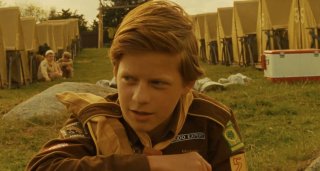
In this scene, the camera has an extended shot that swings around to a close up of each of the characters sitting in a circle. The characters were discussing that since they were going on a rescue operation for Shakusky, who might be disturbed because his family died, that they would bring weapons with them. The Khaki Scout pictured is Redford, Shakusky’s nemesis throughout the film, but his underlying reason is, “Why should I? Nobody else does.”(1:10:46 – 1:11:29 Moonrise Kingdom (2012) Universal Pictures). This photo has the foreground / subject in focus, but the audience can also see what’s in the background and can tell what everything is so it would be considered a medium close up (head and shoulders of the subject). If anything, this scene shows the true intentions of the Khaki Scouts at first: cause harm first, ask questions later.
Editing creates feeling within audiences
Tonal Montage: getting an emotional reaction from the audience; uses emotional meaning of the shots themselves. Intellectual montage – get an unspoken meaning from the shot. For example, this scene focuses on the determination of both Suzy and Sam to keep going on their adventure, while the rest of the Khaki scouts are on the hunt to bring them back with them. Lazy eye holds a bow and arrow with a quiver on his back full of arrows, ready to be used on Sam to bring him back successfully.
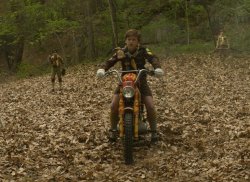
Redford enters the scene on his motorcycle, implying that he holds some sort of authority over the rest of the Khaki Scouts. The editing in this showdown is very humorous and is kind of ambiguous. There’s flashes of different images when Redford starts to approach the young lovers: Suzy’s lefty scissors and an arrow flying through the air. Suddenly it cuts to a landscape scene and you can see the Khaki Scouts running away from something, Redford holds out his hand and shows blood to the camera. Next, it cuts to Suzy and Sam standing on the edge of a cliff, Suzy solemnly looking down at her bloody scissors.
Digetic v. non-digetic sound
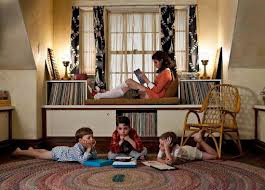
Most of the score is digetic, however, because it is being played by the record player that Suzy “borrows” from her brother. For example, in the beginning the vinyl that Lionel, one of Suzy’s brothers, plays frequently is the one that is most used in the film. It serves a dual purpose because the narration and the classical score go along with the characters’ emotions and reactions. For example, in the beginning of the film, Suzy is shown with an almost brooding look on her face when the soundtrack begins with the dark sounding full orchestra. The score lightens when Suzy and Sam reach mile 3.25 tide inlet, or “Moonrise Kingdom,” and has fluttery, bird like flute sounds. Other digetic sounds that are included are the sounds from the police car driving through unpaved roads and the sound of the boat motor after the parents and Captain Sharp get Suzy and Sam from the inlet.
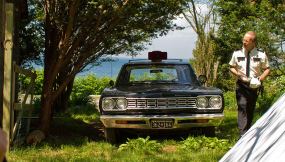
Non-digetic sound that plays for the audience is probably when the record player isn’t being used and is almost always when the camera just depicts the characters travelling and not talking. It’s almost as if it’s the sound of the world around the characters, even if they can’t hear it. Another example would be during the scene that Sam confronts Redford in front of the infirmary tent, they talk but just in the background is the sound of a heart monitor slowly beeping faster and faster until it flat lines when Sam rushes Redford and attacks his stitches.
Genre of the film
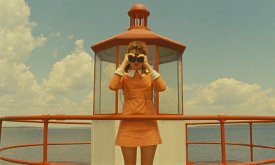
The genre of Moonrise Kingdom is labeled as adventure, comedy and drama. Moreover, an appropriate genre would be a coming-of-age film and could quite possibly be a romantic comedy because it is a love story of two 12-year-old soulmates who find each other, but have goofy characteristics that make the audience chuckle at the young love. Another genre that is included is comedy, for the one-liners and the goofy characteristics of the characters.
 Isabella Susino
Leave a comment